RULA, REBA and OWAS from a video: what the camera measures, and what you still have to tell it
Forge Lens 0.21 scores RULA, REBA and OWAS from a work video on your own PC, using a 17-point body pose model. Which inputs come from the video and which you set yourself, what happens when the worker is out of frame, and what published studies say about how far 2D video scores can be trusted.
On this page
RULA, REBA and OWAS are observational methods. An analyst watches a task, judges each body posture, adds what the posture alone does not show — the load, how the hands hold it, how often the motion repeats — and turns it into a score. The three methods were published in Applied Ergonomics in 1993, 2000 and 1977.
Forge Lens 0.21 does the watching for you. It reads the postures from a video of the task, on your own PC, and scores all three methods for every moment it can see the worker. The part a camera cannot see is still yours to set, and the result tells you how much of the video it actually measured.
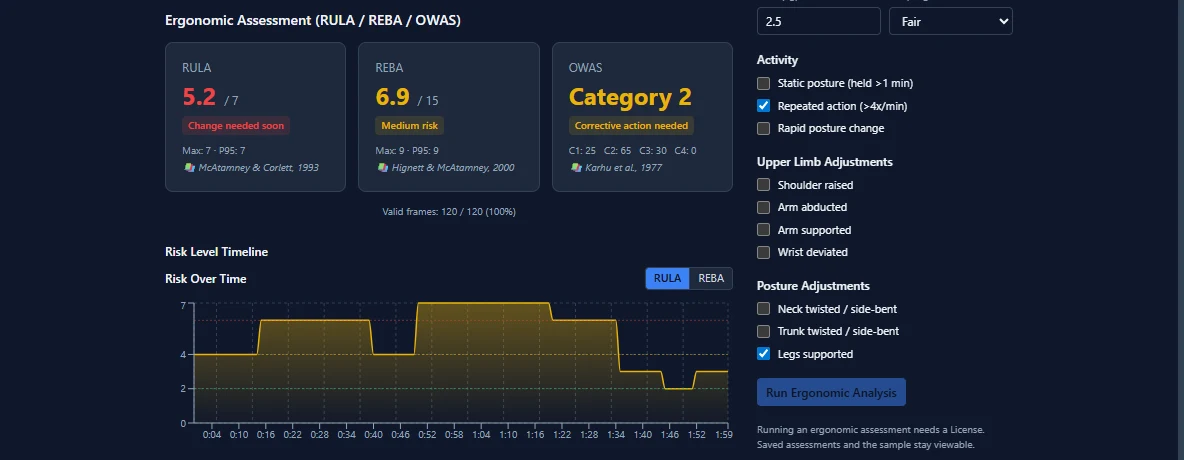
The bundled welding example — synthetic data that ships with the app, with results computed in advance.
What the three methods look at
- RULA (Rapid Upper Limb Assessment, McAtamney and Corlett, 1993) was built for work-related upper limb disorders. It scores the postures of the neck, trunk and upper limbs, together with "muscle function and the external loads experienced by the body", and turns them into an action list that says how urgently the work should be looked at.
- REBA (Rapid Entire Body Assessment, Hignett and McAtamney, 2000) covers the whole body. It adds the static or dynamic loading of the posture, the "human-load interface (coupling)", and upper limbs supported by gravity. The authors published it as a technical note and wrote that "further work is needed to establish the validity of the tool".
- OWAS (Karhu, Kansi and Kuorinka, 1977) came out of a Finnish steel company. It is a method for observing whole-body working postures, with criteria for redesigning them; the criteria were based on ratings by experienced workers and ergonomics experts, and its main focus is the discomfort a posture causes.
What the video measures
Lens finds the worker with MoveNet SinglePose Lightning, a pose model published by Google under the Apache License 2.0. It returns 17 points per frame — nose, eyes, ears, shoulders, elbows, wrists, hips, knees and ankles — each with a confidence. The model downloads once (about 9 MB) the first time you run an assessment. After that, everything runs offline and the video never leaves your PC.
Lens samples the video at two frames per second. From each frame's points it works out:
- trunk and neck flexion,
- upper arm and elbow angles,
- knee angle (for leg posture),
- whether an arm is raised above the shoulder.
The arms are scored on both sides and the worse side counts, because a strain on the left arm is not cancelled by a relaxed right arm.
What you still have to tell it
The 17 points have no hand or finger points, so the angle and twist of the wrist cannot be read from them. A camera also cannot weigh a part or tell whether an arm is resting on a support. These inputs come from you, in Analysis Settings, and apply to the whole video:
- Load / Force: load in kg, and how good the grip is (the REBA coupling grade).
- Activity: a posture held for more than a minute, an action repeated more than four times a minute, rapid posture changes.
- Upper limb: shoulder raised, arm abducted, arm supported, wrist deviated.
- Posture: neck twisted or bent sideways, trunk twisted or bent sideways, legs supported.
If a task has steps with very different loads, split the video into segments and read the per-segment results. Do not average one load over everything.
When the worker is not in the frame
A frame where nobody can be measured is not a good posture. Lens never scores it as one:
- Timeline: a second without a measurable person is a gap in the line, not a zero, and the chart says what its gaps mean.
- Segment table: a segment where nobody was measured reads «Not measured», with no score and no risk colour.
- Summary: shows how many frames were measured, out of how many. On our bundled assembly-line video, the model found the worker clearly enough in 13 of 135 frames. Read a score next to that count.
- No person at all: if the model cannot find a person in any frame, there is no score at all, only a message that says why.
How far a 2D video score can be trusted
Treat a video score as a screening result: a fast way to find the segments that deserve a closer look. It is not a replacement for an assessment by a trained observer. The published evidence points the same way:
- Against motion capture: a 2025 study compared 2D video pose estimation with motion capture using body-worn sensors (IMUs). Total RULA scores agreed moderately (κ = 0.461). The scores for individual body regions — upper arm, forearm, wrist, neck, trunk — did not agree significantly. The authors conclude that the approach can help with a quick overall assessment but is not reliable at the level of individual joints, especially the upper limbs.
- With a stronger 2D pose model: a 2026 study reported a joint-angle error of 5.7° for its 2D pose system, against 10.7° for a Kinect V2 depth camera. It also reported better agreement with experts when REBA's score boundaries are smoothed. These are the authors' figures for their own system.
- How to film: keep the worker whole and in the frame, filmed from the side the work is done on. Measured frames are where the score comes from, so a video in which the worker is hidden behind the fixture gives you few of them.
Try it in Forge Lens
- In Video Library, import a video of the task.
- Split it into segments in Analysis Workspace, by automatic analysis or by marking them yourself. The assessment scores each segment.
- Open Ergonomic Assessment and set the load and activity in Analysis Settings.
- Click Run Ergonomic Analysis.
Running an assessment is part of the Forge Lens License. Saved assessments and the bundled welding example stay viewable without one. To see the dashboard before filming anything, open Templates and add the welding RULA example.
References
- McAtamney, L., & Corlett, E. N. (1993). RULA: a survey method for the investigation of work-related upper limb disorders. Applied Ergonomics, 24(2), 91–99. doi:10.1016/0003-6870(93)90080-S
- Hignett, S., & McAtamney, L. (2000). Rapid Entire Body Assessment (REBA). Applied Ergonomics, 31(2), 201–205. doi:10.1016/S0003-6870(99)00039-3
- Karhu, O., Kansi, P., & Kuorinka, I. (1977). Correcting working postures in industry: A practical method for analysis. Applied Ergonomics, 8(4), 199–201. doi:10.1016/0003-6870(77)90164-8
- Google. MoveNet.SinglePose Model Card. Licensed under the Apache License, Version 2.0.
- Simon, S., et al. (2025). Bioengineering, 12(4), 403. doi:10.3390/bioengineering12040403 — 2D pose estimation compared with IMU motion capture for RULA.
- Li, N., Chen, Y., & Fang, Z. (2026). Ergonomics (online ahead of print). doi:10.1080/00140139.2026.2681927 — monocular pose estimation and fuzzy REBA.