 Forge Tools BlogForge Tools
Action Priority vs RPN: why the AIAG-VDA FMEA stopped multiplying S, O and D
For decades an FMEA ranked its risks by the Risk Priority Number — severity × occurrence × detection, each rated 1 to 10. The harmonized AIAG-VDA FMEA Handbook (first edition, June 2019, published jointly by AIAG and VDA QMC) replaced it. In the handbook's risk analysis step, the team assigns an Action Priority (AP) of High, Medium or Low instead; AIAG described the change as "the Action Priority (AP) methodology and Tables to replace RPN".
What is wrong with S × O × D
The ratings are ordinal: they put failure modes in order, but the distance between a 3 and a 4 is not the distance between a 7 and an 8, and nothing makes a severity point worth an occurrence point. Multiplying them treats them as quantities anyway. Bowles (2003), a widely cited assessment of RPN prioritization, lists the consequences — among them the gaps in the scale and the duplicate values below, both of which can be checked with nothing more than arithmetic.
- Most of the scale does not exist. The 1,000 combinations of three 1–10 ratings produce only 120 different RPN values. 880 of the integers from 1 to 1,000 can never occur, and the ones that can are bunched at the low end: 46 of the 100 values up to 100, but only 17 of the 500 above 500.
- One number, very different risks. RPN 60, 72 and 120 each arise from 24 different combinations. RPN 60 is S 10 · O 2 · D 3, a safety-related effect that is unlikely and fairly well detected. It is also S 2 · O 5 · D 6, a minor annoyance that happens often and is hard to catch. A ranking by RPN, or a fixed RPN threshold, cannot tell them apart.
- Severity has no special standing. Arithmetic alone also shows this one: a point of detection buys exactly as much RPN as a point of severity, so a better detection control lowers the number of a severity-10 failure mode exactly as much as a one-point drop in its severity would.
What Action Priority does instead
AP is not a product of the ratings. AIAG describes the method as assigning priority to actions "while considering severity, occurrence, and detection individually and in combination with risk-reducing factors"; the priority is read from tables. Each combination of S, O and D maps to H, M or L, and the handbook attaches an expectation for action to each level, strongest for H. The tables themselves, and the handbook's wording for each level, are in the handbook; we do not reproduce them here.
Two details from the handbook's errata (version 2, June 2020) matter in practice:
- The AP field takes H, M or L only — "N/A" was removed for DFMEA, PFMEA and FMEA-MSR alike.
- If no action is taken, the AP is not reduced: the risk of failure is unchanged, and so is its priority.
The supplemental FMEA for Monitoring and System Response (FMEA-MSR) has AP tables of its own, rated on monitoring rather than detection — the errata correct those tables separately (§4.6.3).
The same RPN, opposite priorities
Two failure modes from an injection-molding PFMEA, side by side in one worksheet:
| Failure mode | S | O | D | RPN | AP |
|---|---|---|---|---|---|
| Short shot — structural rib missing | 8 | 3 | 3 | 72 | H |
| Sink mark — visible surface defect | 4 | 6 | 3 | 72 | L |
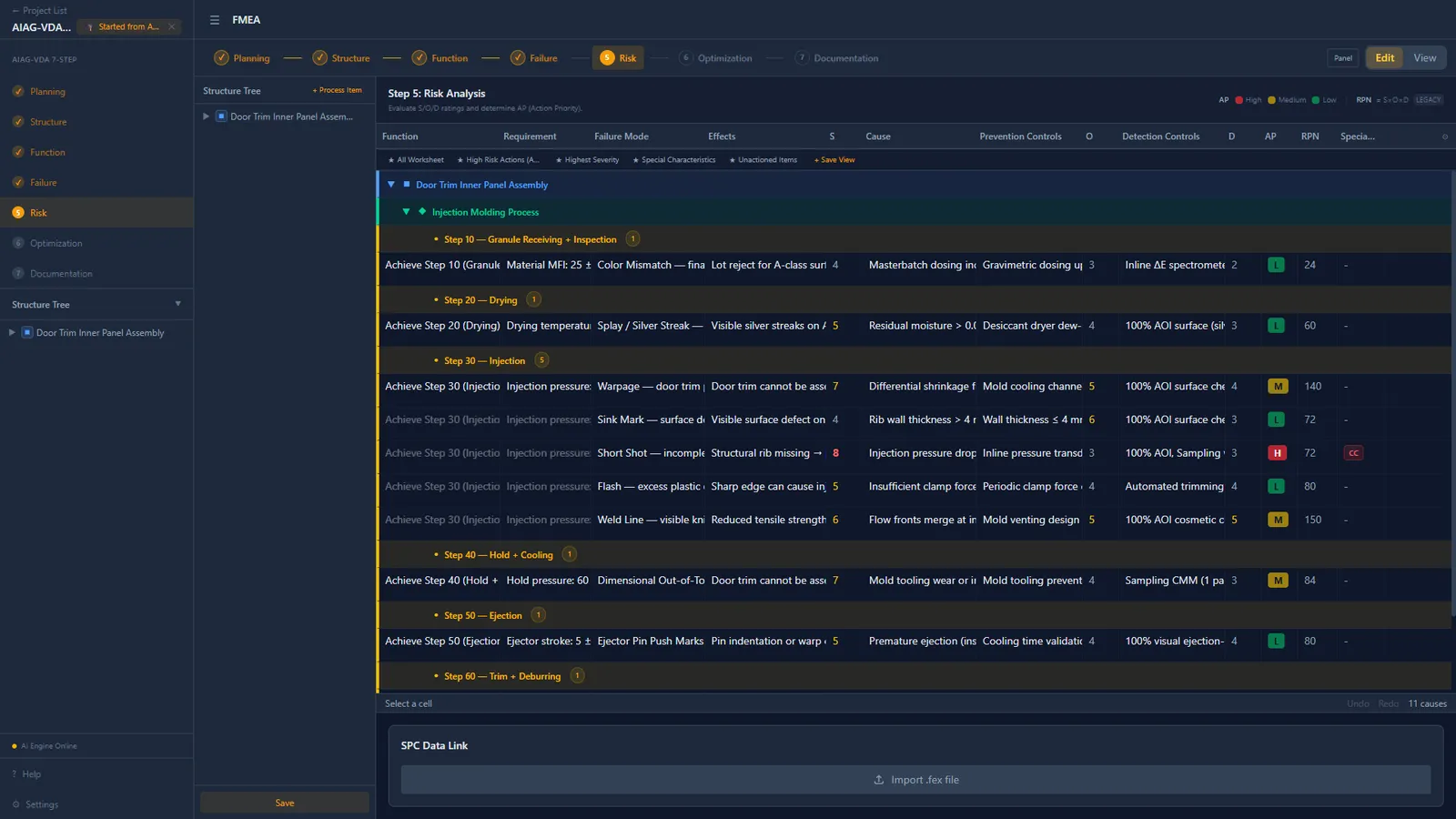
By RPN the two are equal — and both rank below Warpage (S 7, RPN 140) and Weld Line (S 6, RPN 150) on the same sheet. By AP the short shot is the only High item in view: a missing structural rib is a severity-8 effect, and severity carries weight that the product spreads evenly across all three ratings. The sink mark happens twice as often and still ranks Low, because what it costs is cosmetic.
When a customer still asks for RPN
If a customer's requirements still ask for an RPN, report it — but decide what to work on next by AP, and do not let an RPN threshold overrule it.
Try it in Forge FMEA
Forge FMEA follows the AIAG-VDA seven steps. In the risk analysis step every failure mode gets an AP from the AIAG-VDA 2019 tables as you rate it, using the highest severity among its effects (effects on the end user first), and the worksheet can be filtered to the High items. The RPN is shown beside it for reference, labelled as the legacy metric. The worksheet above is the AIAG-VDA PFMEA — Injection Molding sample project that ships with the app.
Forge FMEA runs on your own PC, offline; the data never leaves it.
References
- AIAG & VDA QMC, FMEA Handbook, 1st ed., June 2019 — Action Priority in the risk analysis step.
- AIAG, AIAG & VDA FMEA Handbook Errata, version 2, June 2020.
- VDA QMC, White Paper FMEA — "Die Aufgabenpriorität (AP) ersetzt die Risikoprioritätszahl (RPZ)".
- J. B. Bowles, "An assessment of RPN prioritization in a failure modes effects and criticality analysis", Annual Reliability and Maintainability Symposium, 2003, pp. 380–386, doi:10.1109/RAMS.2003.1182019.